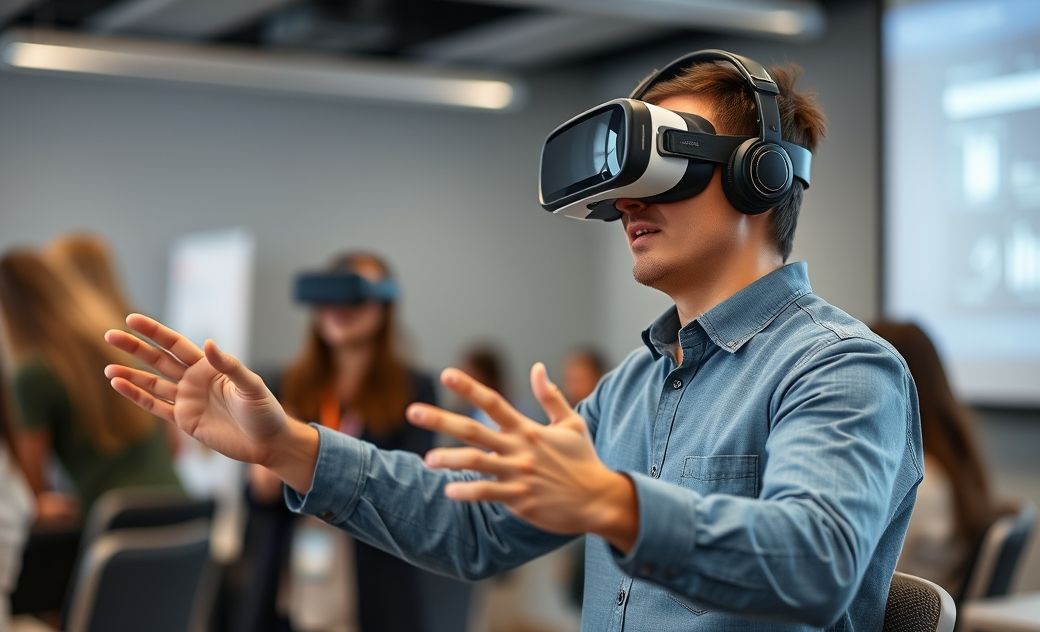
In the rapidly evolving field of education, technology continues to shape and redefine learning experiences. Virtual Reality (VR) has emerged as a transformative tool, particularly in enhancing learning retention rates. As educational institutions strive for more effective teaching methods, understanding the impact of VR can be pivotal in achieving better educational outcomes.
How Virtual Reality Enhances Learning Experiences
Virtual Reality provides an immersive learning environment that traditional teaching methods often fail to deliver. By fully immersing students in a subject, VR allows them to experience and interact with educational content in a highly engaging manner.
Immersive Engagement
One of the most notable impacts of VR in education is its ability to engage students deeply. When learners are placed in a 3D environment that they can explore, the novelty and interactivity increase their interest and focus.
This heightened engagement promotes active learning, a critical factor in ensuring that students absorb and remember information. Instead of being passive recipients, students in a VR setup actively participate in their learning journey.
Enhanced Memory Retention
The sensory-rich experience offered by VR aids in improving memory retention. Studies have shown that people remember information better when multiple senses are engaged. VR incorporates visual, auditory, and kinesthetic learning styles, making it easier for students to retain information.
For example, a history lesson about ancient Rome is more impactful when students can virtually walk through the Colosseum, hearing the sounds and seeing the sights as if they were truly there.
Virtual Reality Versus Traditional Learning Methods
Traditional learning methods primarily rely on reading from textbooks and listening to lectures, which may not cater to all learning styles. VR bridges this gap by providing a diverse learning experience that can accommodate different preferences.
Interactive Simulations
VR allows for the use of interactive simulations, providing a practical application of theoretical concepts. This is particularly beneficial in fields such as science and engineering, where students can conduct experiments in a controlled virtual environment, safely and without the cost of resources.
Moreover, these simulations help in reinforcing theoretical knowledge by allowing students to repeatedly practice and learn from their mistakes without real-world consequences.
Personalized Learning Paths
Unlike static classroom settings, VR can be customized to fit individual learning needs. Adaptive VR programs can adjust the level of difficulty and the type of content based on the learner’s pace and understanding, thereby increasing the effectiveness of the learning process.
The Future of Virtual Reality in Education
As technology continues to advance, the application of Virtual Reality in education is expected to grow exponentially. With devices becoming more affordable and widespread, the barrier to incorporating VR in classrooms is decreasing.
Increased Accessibility
As VR hardware and software become more accessible, schools and educational institutions will be more inclined to incorporate VR into their curriculum. This increased accessibility will democratize learning, providing equal opportunities for students from various backgrounds to benefit from immersive education.
Blended Learning Environments
The future of education likely involves a blend of traditional and virtual learning environments. By integrating VR with conventional classroom techniques, educators can create a comprehensive learning experience that maximizes student engagement and retention.
Ultimately, as VR technology continues to evolve and its application in education becomes more widespread, it will play a crucial role in enhancing learning outcomes and preparing students for the future.